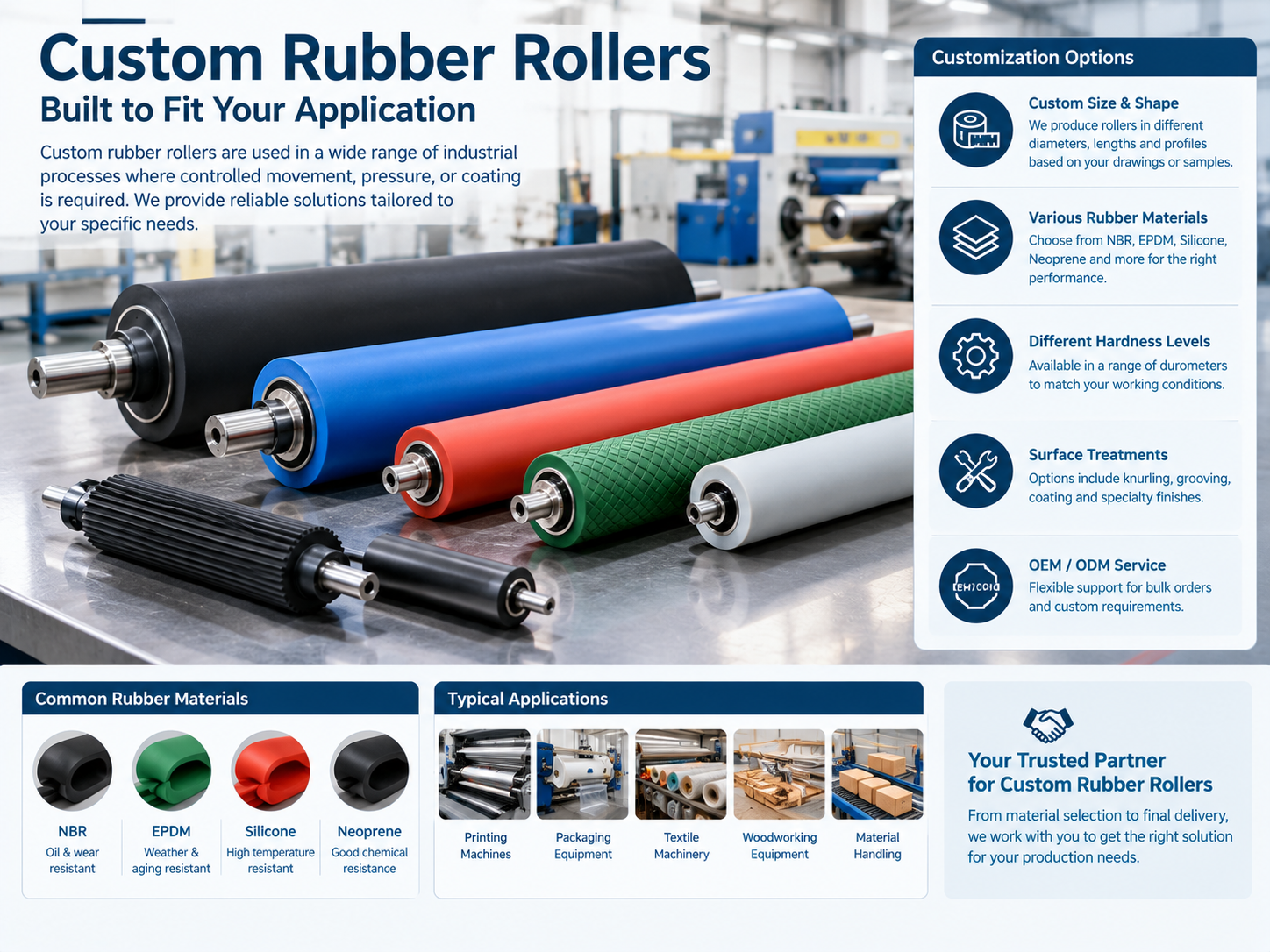
Custom rubber rollers are used in a lot of industrial equipment where materials need to be moved, pressed, coated, fed, wound, laminated, or handled in a controlled way. Printing machines, packaging lines, textile equipment, converting machinery, woodworking systems, and many other production setups may all use rubber rollers, but the requirements are rarely exactly the same.
For B2B buyers, ordering Custom Rubber Rollers is not simply a matter of choosing a size from a catalog. Rubber compound, roller dimensions, core material, hardness, surface finish, tolerances, and bonding all need to suit the actual machine and working conditions.
A roller can look right on a drawing and still cause trouble after installation. Maybe the rubber is too hard. Maybe the diameter is slightly off. Or perhaps the surface does not provide enough grip. That is why it pays to give the manufacturer as much application information as possible before asking for a quotation.
Why Custom Rubber Rollers Need Application-Specific Specifications
Rubber rollers can work in very different environments depending on the machine.
One roller might move paper at high speed. Another may press film during lamination, while a third handles abrasive material on a production line. The loads, temperatures, speeds, and surface requirements can be quite different.
Before contacting a manufacturer, buyers should have information such as:
- Material being processed
- Roller diameter and length
- Working speed
- Operating temperature
- Required hardness
- Contact pressure
- Chemical exposure
- Surface finish
- Expected service life
The more complete this information is, the easier it becomes to select a suitable roller construction.
Rubber Compound Selection Is One of the Most Important Decisions
The outer rubber layer has a direct effect on how the roller behaves during operation.
Different rubber compounds have different levels of resistance to abrasion, oils, chemicals, heat, ozone, and repeated mechanical stress. Common choices include natural rubber, EPDM, NBR, silicone, polyurethane, and various specialty compounds.
| Rubber material |
General characteristic |
Common consideration |
| Natural rubber |
Good elasticity and grip |
Suitable for selected general applications |
| NBR |
Good resistance to oils and fuels |
Useful in oil-contact environments |
| EPDM |
Good weather and ozone resistance |
Suitable for some outdoor and water-related applications |
| Silicone |
Wide temperature capability |
Used where heat resistance is important |
| Polyurethane |
Good wear and abrasion resistance |
Useful for demanding industrial contact |
| Specialty compounds |
Tailored chemical or mechanical properties |
Application-specific selection |
These are only general characteristics. The actual grade should be chosen according to the working environment and the manufacturer's technical data.
Choosing an unsuitable compound may result in swelling, cracking, hardening, poor friction, or premature surface wear.
Rubber Hardness Should Match the Working Conditions
Hardness is another specification that deserves careful attention when ordering Custom Rubber Rollers.
Rubber hardness is commonly measured with Shore scales, with Shore A often used for rubber materials.
A softer roller generally has more flexibility and can conform better to certain surfaces. A harder rubber covering resists deformation more effectively and may work better where pressure and dimensional stability are important.
Still, hardness should not be selected on its own.
| Hardness direction |
Potential characteristics |
| Softer rubber |
Better conformity and cushioning |
| Medium hardness |
Balanced contact and support |
| Harder rubber |
Greater resistance to deformation |
The suitable hardness depends on contact pressure, material being processed, roller speed, surface requirements, and the machine itself.
For a new roller design, testing different hardness options can be a practical way to find the contact behavior the machine actually needs.
Roller Dimensions Need Accurate Measurement
Dimensions become especially important when a roller is replacing an existing part or needs to fit directly into production equipment.
Buyers should provide measurements for:
- Overall length
- Working length
- Outer diameter
- Core diameter
- Shaft diameter
- Shaft length
- Mounting dimensions
- Bearing locations
- Keyways or flats
- Threaded sections
Even a small dimensional difference can create alignment or installation problems.
If drawings are not available, sending the original roller as a physical sample may make things easier. For OEM projects, though, a complete engineering drawing is generally more useful.
The drawing should also show important tolerances. Nominal dimensions alone do not tell the whole story.
Core Material Affects Roller Strength
The rubber covering gets most of the attention, but the core is doing plenty of work underneath it. It supports the rubber and transfers mechanical force or torque through the roller assembly.
Steel cores are widely used because they offer good strength and rigidity. Aluminum may be considered where lower weight is helpful. Other core materials can also be used for particular applications.
Core design should take into account:
- Load
- Bending
- Rotational speed
- Shaft connection
- Bearing arrangement
- Operating temperature
- Corrosion conditions
Long rollers deserve particular attention here. If the core bends too much under load, pressure across the working surface may become uneven, which can affect the production process.
Surface Finish Affects Contact and Grip
The working surface of a rubber roller does not always need to be plain and smooth. Depending on the application, it may be smooth, textured, grooved, crowned, or finished through machining.
Surface treatment affects friction, material movement, coating behavior, and contact pressure.
A smooth surface may work well with certain films or paper products, while another process may need a particular texture to maintain grip.
Buyers should consider specifications such as:
- Surface roughness
- Texture
- Groove pattern
- Groove depth
- Crown profile
- Polishing requirements
There is no single surface finish that works for every roller. It needs to match the material and the result expected from the process.
Roller Crowning Can Help With Contact Distribution
Some rollers are made with a slight crown, meaning the center section has a slightly larger diameter than the ends.
In suitable applications, this profile can help distribute contact across the working width and compensate for some roller deflection under load.
Whether a crown is needed depends on factors including:
- Roller length
- Load
- Core stiffness
- Contact pressure
- Machine arrangement
- Material width
It is easy to assume that a crowned roller is automatically better. It is not that simple. The profile should be established according to the actual machine conditions.
Operating Speed Should Be Provided to the Manufacturer
Roller speed affects both mechanical behavior and heat generation.
At higher speeds, centrifugal forces, frictional heating, and balancing requirements become more noticeable. For that reason, buyers should provide the expected RPM and, when available, the speed of the material moving through the machine.
The manufacturer may need to consider:
- Dynamic balance
- Core strength
- Rubber adhesion
- Surface heat buildup
- Bearing arrangement
- Maximum safe operating speed
This information matters even more with long rollers or equipment used in high-speed printing and converting.
Temperature Can Change Rubber Performance
Rubber does not behave exactly the same at every temperature.
Some compounds become softer as temperature rises, while low temperatures can reduce flexibility. Continuous exposure to high temperatures may also speed up material aging.
For thermal applications, provide both normal operating temperature and peak temperature whenever possible.
| Temperature condition |
What buyers should consider |
| Normal room temperature |
General material suitability |
| Elevated temperature |
Heat resistance and aging |
| Low temperature |
Flexibility and cracking risk |
| Rapid temperature changes |
Thermal cycling effects |
| Direct heat exposure |
Compound and core selection |
Silicone and certain specialty elastomers may suit higher-temperature applications, but the exact material still needs to be checked against the actual process.
Chemical Exposure Needs to Be Clearly Identified
Rubber rollers may come into contact with inks, solvents, oils, cleaning fluids, adhesives, water, or other chemicals during normal operation.
An unsuitable rubber compound can swell, soften, harden, crack, or lose its bond with the core after chemical exposure.
This is why buyers should tell the manufacturer exactly which chemicals are involved, ideally with technical information or product specifications.
Simply saying that a roller needs to be “solvent-resistant” may not provide enough information. Different solvents can affect elastomers in very different ways.
If chemical exposure is a major concern, testing a sample before full production can provide useful confirmation.
Bonding Quality Matters for Long-Term Performance
The rubber covering needs to stay firmly attached to the core throughout the roller's working life.
If the bonding process is poor, the rubber may separate, blister, or peel after repeated loading.
Bonding depends on several things, including metal surface preparation, adhesive selection, curing conditions, rubber formulation, and production control.
For custom projects, buyers can ask:
- How is the metal core prepared?
- What bonding system is used?
- How is curing controlled?
- How is adhesion inspected?
- Are bond-strength tests performed?
For rollers operating at high speed or under heavy loads, rubber-to-core adhesion is particularly worth checking.
Balancing Tolerances and Production Cost
Custom rollers often require tighter tolerances than standard products, but tighter tolerances also tend to increase machining, grinding, inspection, and production costs.
The sensible approach is to define tolerances around actual machine requirements.
| Parameter |
Example purchasing consideration |
| Outer diameter |
Fit and contact accuracy |
| Diameter tolerance |
Affects pressure and material handling |
| Concentricity |
Supports stable rotation |
| Straightness |
Important for long rollers |
| Surface roughness |
Influences friction and finish |
| Shaft dimensions |
Determines installation compatibility |
There is little benefit in specifying extremely tight tolerances for dimensions that have no real effect on machine performance.
An experienced manufacturer should be able to help identify which dimensions genuinely need tighter control.
Dynamic Balance Is Important for High-Speed Rollers
When a roller spins quickly, even a relatively small imbalance can create noticeable vibration.
That vibration may affect:
- Surface quality
- Bearing life
- Machine noise
- Rubber wear
- Product consistency
High-speed rollers may therefore need dynamic balancing. The actual requirement depends on roller dimensions, RPM, machine construction, and how sensitive the application is to vibration.
Give the manufacturer the expected operating speed and ask whether balancing is included, along with the applicable standard or tolerance.
Quality Control Should Cover the Complete Roller
Inspection should not stop at checking whether the rubber surface looks good.
A custom roller usually needs both mechanical and rubber-related inspections.
| Inspection area |
What it verifies |
| Core dimensions |
Installation and mechanical fit |
| Rubber hardness |
Consistency of the covering |
| Outer diameter |
Contact and machine compatibility |
| Concentricity |
Rotational stability |
| Surface finish |
Contact performance |
| Rubber thickness |
Uniform covering |
| Bonding |
Adhesion between rubber and core |
| Balance |
High-speed operating stability |
For larger orders, it is also worth asking how the manufacturer keeps these characteristics consistent between production batches.
Sample Approval Is Useful for Custom Roller Orders
A sample can uncover problems that are easy to miss on a drawing.
Before moving into mass production, buyers can install the sample on the actual machine and check:
- Fit
- Rotation
- Pressure
- Surface contact
- Material handling
- Noise
- Vibration
- Product finish
Testing under conditions close to real production gives both sides useful information.
For new OEM projects, an approved sample can also become the reference point for future repeat orders.
Maintenance Requirements Should Be Considered Before Purchasing
Roller service life depends on the design, but operating and maintenance practices matter too.
Routine care may include cleaning the working surface, checking bearings, inspecting the rubber, and removing material buildup or contamination.
Cleaning products should be compatible with the rubber compound.
Operators should keep an eye out for:
- Cracking
- Swelling
- Surface glazing
- Excessive wear
- Flat spots
- Delamination
- Diameter changes
These signs can provide an early warning that the roller material, machine setup, or operating conditions need attention.
What Should B2B Buyers Ask a Custom Rubber Roller Manufacturer?
Before placing an order, buyers should provide the technical details they already have and ask a few practical questions.
| Question |
Why it matters |
| Which rubber compounds are available? |
Matches material to the application |
| What hardness range can be produced? |
Supports proper contact behavior |
| What dimensional tolerances are possible? |
Confirms fit and accuracy |
| Can the core be customized? |
Supports OEM integration |
| What surface finishes are available? |
Matches friction and handling needs |
| Can the roller be dynamically balanced? |
Useful for high-speed applications |
| What bonding process is used? |
Supports long-term durability |
| What testing is performed? |
Provides evidence of quality control |
| Are samples available? |
Allows actual machine testing |
| Can repeat orders match the approved sample? |
Important for long-term supply |
The answers can tell buyers quite a bit about the supplier's engineering and production capabilities.
Custom Rubber Rollers Can Be Developed Around Specific Machines
Customization becomes useful when an off-the-shelf roller does not fit the machine or cannot meet the process requirements.
Depending on the project, manufacturers may customize:
- Roller dimensions
- Rubber compound
- Hardness
- Surface finish
- Crown profile
- Groove pattern
- Core material
- Shaft design
- Mounting configuration
- Branding and packaging
For OEM work, CAD drawings, machine specifications, and operating conditions are useful starting points.
The manufacturer can review the design before production and flag possible concerns involving deflection, tolerances, bonding, or material selection.
A Practical Checklist Before Ordering Custom Rubber Rollers
Before asking for a final quotation, B2B buyers can prepare the following information:
Application: What material will the roller contact?
Dimensions: What are the exact roller and shaft dimensions?
Speed: What is the maximum operating RPM?
Load: What pressure or mechanical load will be applied?
Rubber: What hardness and compound are required?
Environment: What temperatures, chemicals, moisture, and contaminants are present?
Surface: Should the roller be smooth, grooved, textured, or crowned?
Quality: Which dimensions and performance characteristics are critical?
Quantity: How many samples and production units are required?
Having these details ready can save a fair amount of back-and-forth and gives the manufacturer a better basis for preparing a quotation.
Making the Right Choice for Custom Rubber Rollers
Choosing Custom Rubber Rollers is really an application-matching exercise. The roller has to fit the machine mechanically, but that is only part of the job. Its rubber characteristics also need to suit the material, speed, load, temperature, and surrounding environment.
Important specifications include the rubber compound, hardness, dimensions, core material, surface finish, crown profile, bonding method, tolerances, and balancing requirements. When the roller is intended for a new or demanding application, sample testing is particularly useful.
A capable manufacturer should be able to discuss these technical points, provide drawings or samples, explain its inspection methods, and make design adjustments when standard specifications do not fit the equipment.
Getting the working conditions clear before ordering and confirming critical dimensions through testing can reduce fitment issues and make sourcing more predictable, both for the initial production run and for repeat orders.

 Español
 Deutsch