
 Español
 Deutsch

Does Roller Diameter Change the Performance of a Carbon Fiber Roller?
Rollers are used in many production systems to guide, transport, wind, unwind, coat, laminate, print, or handle continuous materials. In high-speed equipment, roller design can have a direct effect on production stability, material quality, and machine efficiency.
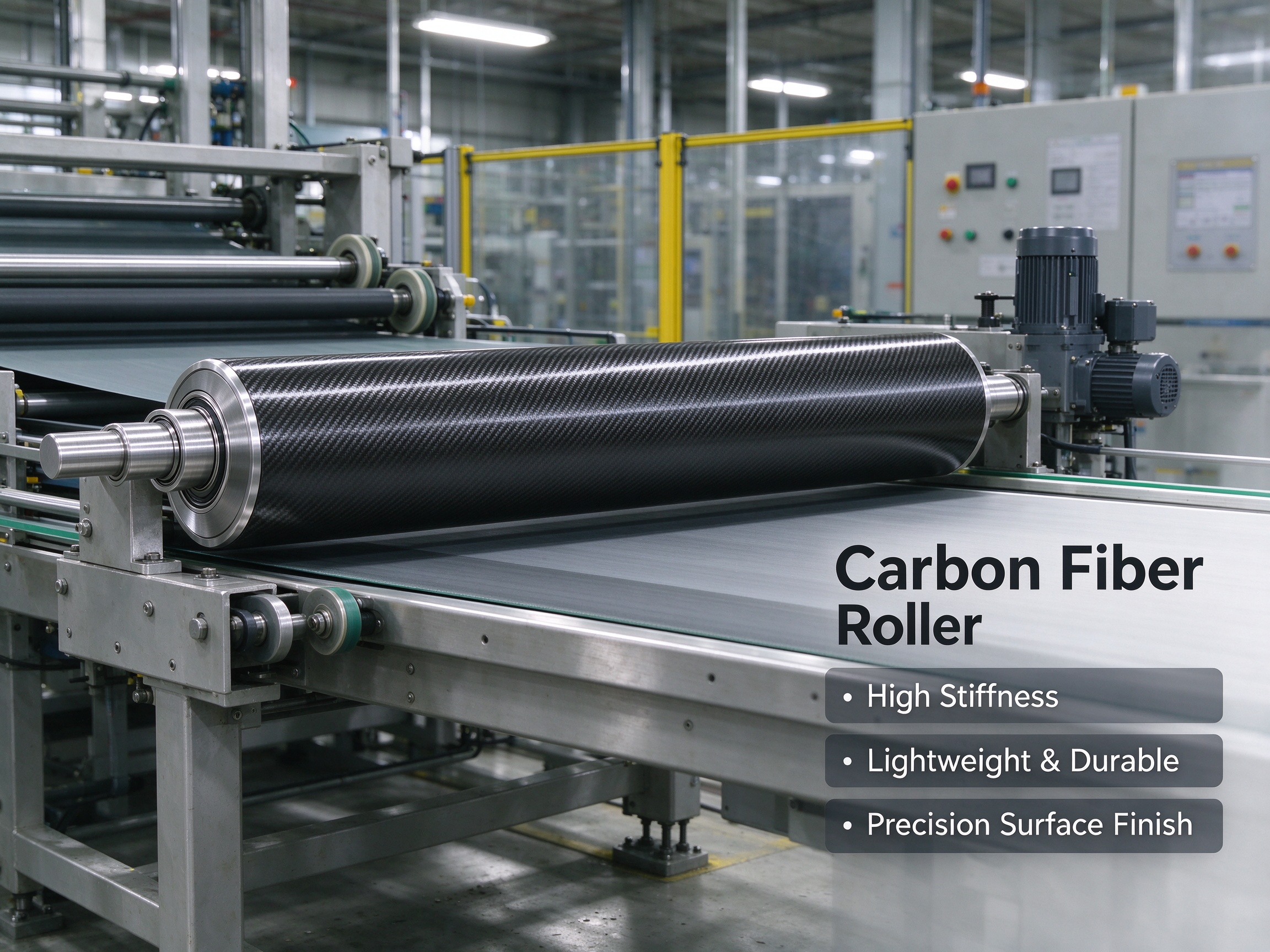
For applications that demand low rotating mass and good stiffness, carbon fiber has become a useful material for roller construction. A Carbon Fiber Roller can be designed with a high strength-to-weight ratio, which is attractive for printing, converting, textile, film, battery, automation, and other web-handling equipment.
But choosing carbon fiber alone does not determine how the roller will perform. Diameter is another important variable.
Changing roller diameter can affect rotational speed, bending behavior, inertia, web contact, surface speed, bearing loads, and the mechanical response of the complete machine. A larger roller may provide better stiffness and lower rotational speed at the same line speed, while a smaller roller can reduce physical size and may be suitable where space is limited.
For B2B buyers and equipment manufacturers, the right diameter should therefore be selected according to the actual operating conditions instead of treating it as a simple dimensional preference.
Why Roller Diameter Matters in Web-Handling Equipment
The relationship between roller diameter and line speed is straightforward.
For a roller rotating at a given RPM, a larger diameter produces a higher surface speed. Conversely, if the line speed remains constant, increasing the roller diameter reduces the required rotational speed.
The basic relationship is:
Surface Speed = π × Roller Diameter × Rotational Speed
For example, if the web must travel at 100 meters per minute, a smaller roller needs to rotate faster than a larger one to achieve the same surface speed.
| Roller diameter | Required rotational speed at 100 m/min |
|---|---|
| 50 mm | About 637 rpm |
| 100 mm | About 318 rpm |
| 150 mm | About 212 rpm |
| 200 mm | About 159 rpm |
These figures are simplified calculations and assume the roller surface speed matches the web speed without slip.
This relationship becomes important in high-speed machinery because rotational speed influences bearings, balance requirements, drive behavior, and aerodynamic effects.
How Diameter Affects the Rotational Speed of a Carbon Fiber Roller
At the same production line speed, a larger-diameter roller rotates more slowly.
That can be useful in systems where high RPM creates additional mechanical challenges. Lower rotational speed can reduce some bearing and balancing demands, although the actual result still depends on roller construction and machine design.
A smaller roller requires higher RPM, which may be completely suitable for an application when the roller is correctly balanced and manufactured for that speed.
For example, high-speed film or paper handling equipment may use relatively large rollers where line speed is high and stable web control is important. Compact guide rollers in other parts of the machine can use smaller diameters when space or web-path geometry is the main concern.
The point is not that large diameter is always preferable. The operating speed needs to be evaluated together with roller structure and application requirements.
Larger Diameter Can Improve Roller Stiffness
One of the key reasons to increase roller diameter is mechanical stiffness.
A rotating roller can experience bending when the web tension, contact pressure, or external load is distributed across its width. If deflection becomes excessive, the roller may not maintain the required geometry.
Diameter can have a strong influence on bending stiffness because a larger cross-sectional structure can resist deflection more effectively.
For a Carbon Fiber Roller, this benefit can be combined with the stiffness characteristics of a composite tube. The final result depends on the carbon fiber layup, wall thickness, core design, support structure, and manufacturing method.
A larger diameter may therefore be useful when:
- The roller is relatively wide
- Web tension is high
- Uniform contact is important
- Deflection needs to be controlled
- The roller spans a significant distance between bearings
For precision equipment, stiffness should be checked through engineering calculations or finite element analysis where appropriate.
Smaller Diameter Can Be Useful When Space Is Limited
Not every machine can accommodate a large roller.
Compact production equipment may have strict restrictions around the web path, machine frame, guarding, or nearby components. A smaller roller can reduce the required installation envelope and allow tighter routing.
Smaller rollers may also be useful when the web needs to change direction within a limited space.
However, reducing diameter changes more than the physical size. It also increases rotational speed at a fixed line speed and can increase the amount of curvature imposed on certain flexible materials.
This is why compact dimensions should not be the only selection criterion.
Roller Diameter Changes the Curvature of the Material
The material being transported around a roller experiences bending.
A smaller roller creates a tighter bend, while a larger roller provides a larger bending radius.
This can matter for materials such as thin films, coated webs, foils, laminates, battery materials, textiles, and other flexible products.
The effect depends on material structure. A stiff laminate may behave differently from a thin polymer film. A coated material can also have restrictions related to cracking, delamination, or surface deformation.
When selecting roller diameter, buyers should therefore provide information about:
- Web thickness
- Material type
- Coating structure
- Web tension
- Production speed
- Allowable bend radius
A manufacturer can then determine whether the proposed roller diameter is appropriate for the material path.
Contact Area Changes With Roller Diameter
Diameter also affects how the web interacts with the roller.
A larger roller can provide a different wrap geometry and contact arc depending on the machine layout. This may influence traction, web stability, and the amount of surface available for certain coating or processing operations.
The actual contact area is determined by the web path and wrap angle, so diameter should be considered as part of the entire machine geometry.
For example, a guide roller with a very small diameter may redirect the web sharply. A larger diameter can provide a gentler path and may be preferable for sensitive materials.
This becomes particularly important in web-handling applications where tension and alignment need to remain stable through multiple roller sections.
Diameter Influences Rotational Inertia
A roller's diameter also affects its moment of inertia.
Larger rotating bodies can store more rotational energy, depending on mass distribution. This can influence acceleration and deceleration behavior.
Carbon fiber is useful in this area because its low density allows engineers to design a roller that remains relatively lightweight even when a larger diameter is required.
However, the final inertia depends on the complete construction. Wall thickness, end fittings, shafts, coatings, balancing components, and internal structures all contribute.
For machines that repeatedly accelerate and stop, such as indexing, printing, or converting systems, rotational inertia can become an important design parameter.
Carbon Fiber Construction Can Help Offset the Weight of Larger Diameters
A larger roller generally means more material, but the material itself does not have to make the roller excessively heavy.
Carbon fiber composites are attractive because manufacturers can tailor the reinforcement and structure to deliver stiffness with relatively low mass compared with many traditional metallic designs.
This can create a useful combination:
Larger diameter + lightweight construction = increased stiffness without the same weight penalty as some metal rollers
The actual weight reduction varies by design, because carbon fiber rollers may include metal shafts, end caps, adhesive layers, balancing components, or other materials.
B2B buyers should therefore compare the complete roller assembly weight, not just the weight of the carbon fiber tube.
How Diameter Affects Roller Deflection Across the Width
Wide rollers can experience bending even when the total load seems moderate.
Imagine a long roller supported at both ends. As web tension or pressure acts on its surface, the middle section can deflect. Excessive deflection may contribute to uneven web contact or tension distribution.
Diameter is one way to increase structural stiffness, but it is not the only variable.
Manufacturers may also adjust:
- Composite layup
- Wall thickness
- Core structure
- Shaft diameter
- Bearing spacing
- End support design
This is why two rollers with the same outside diameter can perform differently.
For OEM buyers, the roller width and support configuration should be supplied together with the desired diameter.
Surface Finish Still Matters After Diameter Is Selected
A correctly sized roller can still perform poorly if the surface finish is unsuitable.
Depending on the process, a roller may require a smooth surface, specific roughness, a coating, or a specialized treatment.
Surface characteristics can affect:
- Web traction
- Slippage
- Scratching
- Material contamination
- Coating transfer
- Cleaning
- Static behavior
For film, paper, textile, and foil applications, surface quality can be closely connected to final product appearance.
A carbon fiber tube may provide the structural base, but the working surface may include another material or coating designed for the process.
Roller Diameter Can Affect Edge Tracking and Web Stability
Web handling systems need to keep material aligned while it travels through the machine.
Roller diameter is one of several factors that can influence the web path. Improper geometry, excessive deflection, incorrect alignment, or inconsistent roller surface conditions can contribute to tracking problems.
A larger and stiffer roller may help maintain geometric stability in some applications, especially when the span is wide.
However, edge tracking is a system-level problem. Roller diameter alone cannot correct poor frame alignment, incorrect tension control, worn bearings, or a poorly designed web path.
This is why experienced machine builders evaluate the complete transport path.
How Diameter Affects Bearing and Shaft Design
Changing roller diameter can also change the mechanical interface.
A larger roller may require a different shaft arrangement, bearing spacing, or end connection to maintain stiffness. A smaller roller may allow a more compact bearing structure.
The bearing itself must be selected according to operating speed, radial load, temperature, and expected service life.
| Design variable | Effect of increasing roller diameter |
|---|---|
| Surface speed at same RPM | Increases |
| RPM at same line speed | Decreases |
| Potential bending stiffness | Generally increases |
| Web bend radius | Increases |
| Space requirement | Increases |
| Possible rotational inertia | Increases, depending on construction |
| Required shaft design | May need adjustment |
| Installation weight | Depends on composite construction |
These trends are general engineering relationships. The final roller specification needs to be calculated for the actual machine.
High-Speed Applications Need Dynamic Balancing
As roller speed increases, balance becomes increasingly important.
A small mass imbalance in a rotating roller can create centrifugal forces that result in vibration. At higher RPM, even small inconsistencies can become noticeable.
This is particularly important for small-diameter rollers because they rotate faster at the same web speed.
A professional roller manufacturer may therefore perform dynamic balancing on the complete rotating assembly.
For B2B buyers, it is worth asking:
At what speed is the roller balanced?
Is balancing performed with shafts and end components installed?
What balance specification is used?
These details are more useful than simply being told that the roller has been “balanced.”
Diameter Selection Should Match the Production Process
Different industries can have very different requirements.
| Application | Diameter considerations |
|---|---|
| Flexible film handling | Bend radius and web tension |
| Paper converting | Width, stiffness, speed, and surface finish |
| Textile machinery | Web path, traction, and contamination control |
| Printing | Dynamic balance, surface condition, speed |
| Battery manufacturing | Material sensitivity, cleanliness, web tension |
| Packaging machinery | Space, speed, and repeated acceleration |
| Coating lines | Surface quality, wrap angle, and dimensional stability |
A roller used for a delicate coated film should not automatically be specified using the same criteria as a heavy industrial conveying roller.
What B2B Buyers Should Tell a Carbon Fiber Roller Manufacturer
A supplier can make a more useful recommendation when the buyer provides complete operating data.
Key information usually includes:
- Roller diameter
- Roller face width
- Overall length
- Line speed
- Maximum RPM
- Web material
- Web thickness
- Web tension
- Required surface finish
- Shaft dimensions
- Bearing arrangement
- Operating temperature
- Cleanroom or contamination requirements, where applicable
For custom products, it is also useful to provide drawings or interface dimensions.
The manufacturer can then evaluate whether the proposed diameter is suitable or whether changes to wall thickness, shaft size, layup, or support structure are needed.
Testing the Roller Before Bulk Production
For an OEM or large-volume order, sample validation can help prevent expensive problems.
A suitable test can examine the roller at the intended line speed and under representative web tension. Buyers can monitor vibration, noise, temperature, surface condition, and web tracking.
For precision systems, dimensional checks and runout measurements can also be important.
The goal is to confirm the complete assembly, not only the carbon fiber tube.
A roller can have impressive material specifications but still require adjustment if the shaft interface, balance, surface finish, or support geometry is not appropriate for the production machine.
Selecting the Right Diameter for a Carbon Fiber Roller
Roller diameter has a clear influence on Carbon Fiber Roller performance. It affects rotational speed, bending stiffness, web curvature, contact geometry, inertia, installation space, and the design requirements of shafts and bearings.
A larger diameter can provide greater structural stiffness and a gentler web bend, while a smaller diameter can fit compact machine layouts and provide tighter web-path geometry. Neither direction is automatically better.
For B2B buyers, diameter should be selected from the actual operating requirements: line speed, roller width, web material, tension, allowable bend radius, machine space, and dynamic performance. Factory testing and prototype validation can then confirm whether the chosen roller behaves as expected under production conditions.
The strongest roller specification is usually the one that fits the complete machine, not simply the one with the largest or smallest diameter.

We specialize in manufacturing aluminum guide rolls, air shafts, steel rolls, rubber rolls, curved rolls, slip shafts, magnetic powder brakes, and other mechanical supporting products.
©2025 Ruian Baixiao Machinery Co., Ltd.

Aluminum Guide Rollers Manufacturer