
 Español
 Deutsch


When Should Industrial Buyers Choose Custom Steel Rollers Heavy Duty Instead of Standard Models?
A conveyor roller that works well on one production line may fail surprisingly quickly on another. The difference might be the weight of the material, the distance between supports, the operating speed or simply the amount of time the conveyor runs each day. Replacing worn rollers with the same standard model often does little to solve the problem.
Custom Steel Rollers Heavy Duty are worth considering when the existing roller design no longer suits the machinery or working conditions. Rather than choosing a thicker roller by default, manufacturers can adjust the shaft, steel shell, bearings and surface treatment to address the actual cause of failure.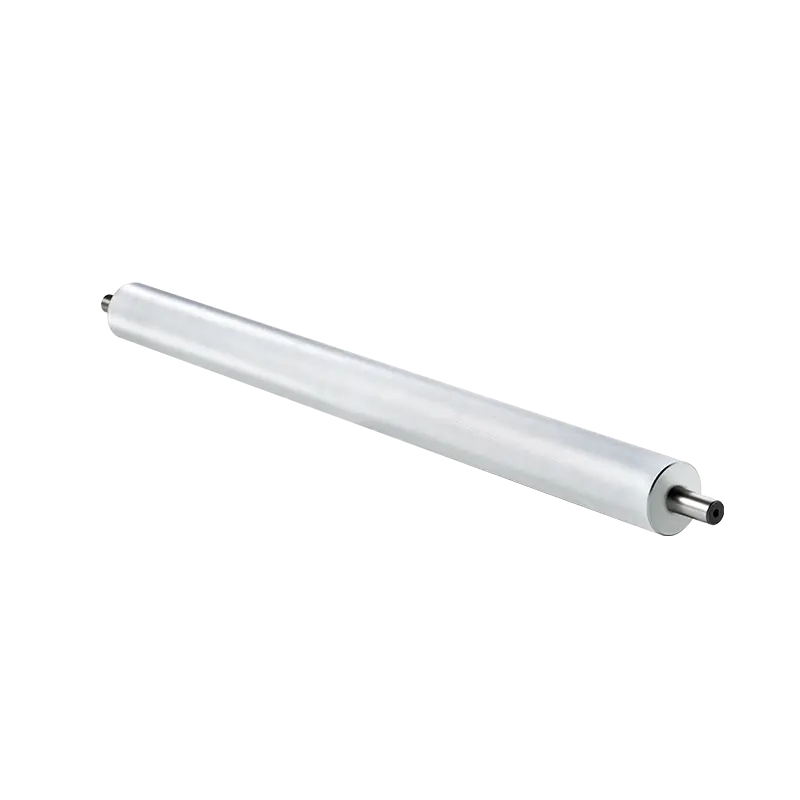
When Rollers Start Deforming Under Heavy Loads
Heavy materials place considerable pressure on conveyor rollers, particularly when loads are concentrated over a small contact area. A roller with insufficient wall thickness may begin to deform, while an undersized shaft can bend under continuous loading.
Bearing failure is another possibility. Even when the steel shell remains intact, overloaded bearings can develop excessive wear and eventually affect the entire conveyor system.
Custom specifications allow engineers to reconsider the construction, including:
- Increasing shell thickness where additional stiffness is needed.
- Using a larger shaft diameter to limit deflection.
- Reinforcing end discs and shaft connections.
- Selecting bearings with suitable load ratings.
- Adjusting the roller structure to distribute loads more evenly.
There is little value in making the shell heavier if the shaft or bearing remains the weakest part. The complete assembly needs to be checked against the expected load, including the supporting conveyor structure.
When Existing Roller Dimensions Are Difficult to Match
Standard rollers are convenient when the conveyor uses common dimensions. Older machinery and specially designed production lines are another matter. Their roller lengths, shaft extensions and mounting arrangements may not match readily available products.
A custom roller can be manufactured to the existing installation rather than requiring modifications to the entire conveyor.
Common requirements include unusual outer diameters, nonstandard lengths, special shaft ends, different bearing positions and specific mounting interfaces.
Buyers should provide a drawing wherever possible. At minimum, the manufacturer needs the overall length, usable roller face, shaft diameter, extension length, bearing arrangement and dimensional tolerances.
Getting these measurements right matters. A roller that fits into the mounting brackets but sits slightly out of alignment can introduce uneven loading and unnecessary friction.
When the Working Environment Damages Ordinary Steel Rollers
A conveyor operating inside a dry warehouse has very different requirements from one exposed to rain, chemicals or abrasive materials.
The surface treatment and steel specification should reflect the actual environment.
For example, humid production areas may require better corrosion protection. Conveyors handling abrasive materials may benefit from wear-resistant surfaces, while chemical processing equipment needs materials and coatings compatible with the substances present.
Possible finishing options include powder coating, industrial painting, plating and other protective treatments. Their suitability depends on how the roller contacts the transported material. A coating that performs well against moisture may wear away quickly under continuous abrasion.
Chemical concentration, operating temperature and cleaning procedures should all be included when discussing material and coating specifications with the supplier.
When Speed, Impact and Continuous Operation Become Problems
Some standard rollers are designed for ordinary conveying speeds and loading conditions. High-speed systems, impact sections and continuously operating production lines can place additional demands on the shaft, bearings and roller shell.
Excessive runout or poor concentricity may cause vibration as rotational speed increases. Incorrect bearing selection can also result in overheating and premature wear.
In these applications, engineers may need to review shaft stiffness, bearing configuration, rotor balance and fatigue resistance. Irregular materials and repeated impact loads may require a different shell structure or stronger connections.
Rather than automatically increasing the roller diameter, the manufacturer should identify which component is limiting performance.
Standard and Custom Heavy-Duty Rollers Compared
| Evaluation factor | Standard steel rollers | Custom heavy-duty steel rollers |
|---|---|---|
| Dimensions | Common predefined sizes | Made to specified equipment dimensions |
| Load capacity | Based on standard product ratings | Configured for particular loading conditions |
| Material | Available standard grades | Selected according to the application |
| Surface treatment | Common industrial finishes | Can be specified for particular environments |
| Delivery | Often faster when stocked | Usually requires production time |
| Initial cost | Generally lower | Usually higher |
| Applications | Conventional conveyor systems | Specialized or demanding installations |
A standard roller is often the sensible purchase when its published specifications already cover the working conditions. Custom manufacturing becomes more attractive when standard products require repeated modification or have a history of premature failure.
Look at Replacement Costs and Production Downtime
The purchase price is easy to compare. The cost of a roller failing in the middle of a production run is harder to overlook.
Repeated bearing replacements, shaft repairs and conveyor stoppages can quickly outweigh the initial price difference between standard and custom components.
Before changing specifications, buyers should examine maintenance records. How frequently are rollers replaced? Are failures concentrated around particular sections of the conveyor? Is the problem associated with bearing wear, surface damage or shaft deformation?
These details help determine whether customization is likely to solve the problem.
The financial comparison should include manufacturing costs, expected service life, maintenance labor, replacement frequency, downtime and spare-parts inventory. A more expensive roller is not automatically more economical; its performance needs to justify the additional cost.
What the Manufacturer Needs Before Quoting
A supplier cannot recommend a suitable roller based on the phrase "heavy duty" alone. The working conditions and installation dimensions need to be clear.
| Information | Purpose |
|---|---|
| Normal and maximum load | Establishes structural requirements |
| Roller length and diameter | Determines installation compatibility |
| Operating speed | Helps select bearings and assess balance |
| Working environment | Guides material and coating selection |
| Daily operating hours | Helps evaluate fatigue and service life |
| Shaft and bearing details | Defines mounting and load transfer |
| Surface requirements | Establishes wear and corrosion protection needs |
Buyers should also ask about welding quality, machining tolerances, material traceability and load testing. If a supplier recommends a thicker shell or larger shaft, there should be an engineering reason behind that recommendation.
For complicated projects, reviewing a technical drawing and prototype before mass production can prevent expensive changes later.
Custom rollers are most valuable when they solve a specific problem that standard products cannot. Sometimes that means a larger shaft; sometimes it means a different bearing, a better surface treatment or simply more accurate mounting dimensions. Identifying the actual weakness of the existing conveyor is a much better starting point than ordering the heaviest roller available.

We specialize in manufacturing aluminum guide rolls, air shafts, steel rolls, rubber rolls, curved rolls, slip shafts, magnetic powder brakes, and other mechanical supporting products.
©2025 Ruian Baixiao Machinery Co., Ltd.

Aluminum Guide Rollers Manufacturer